



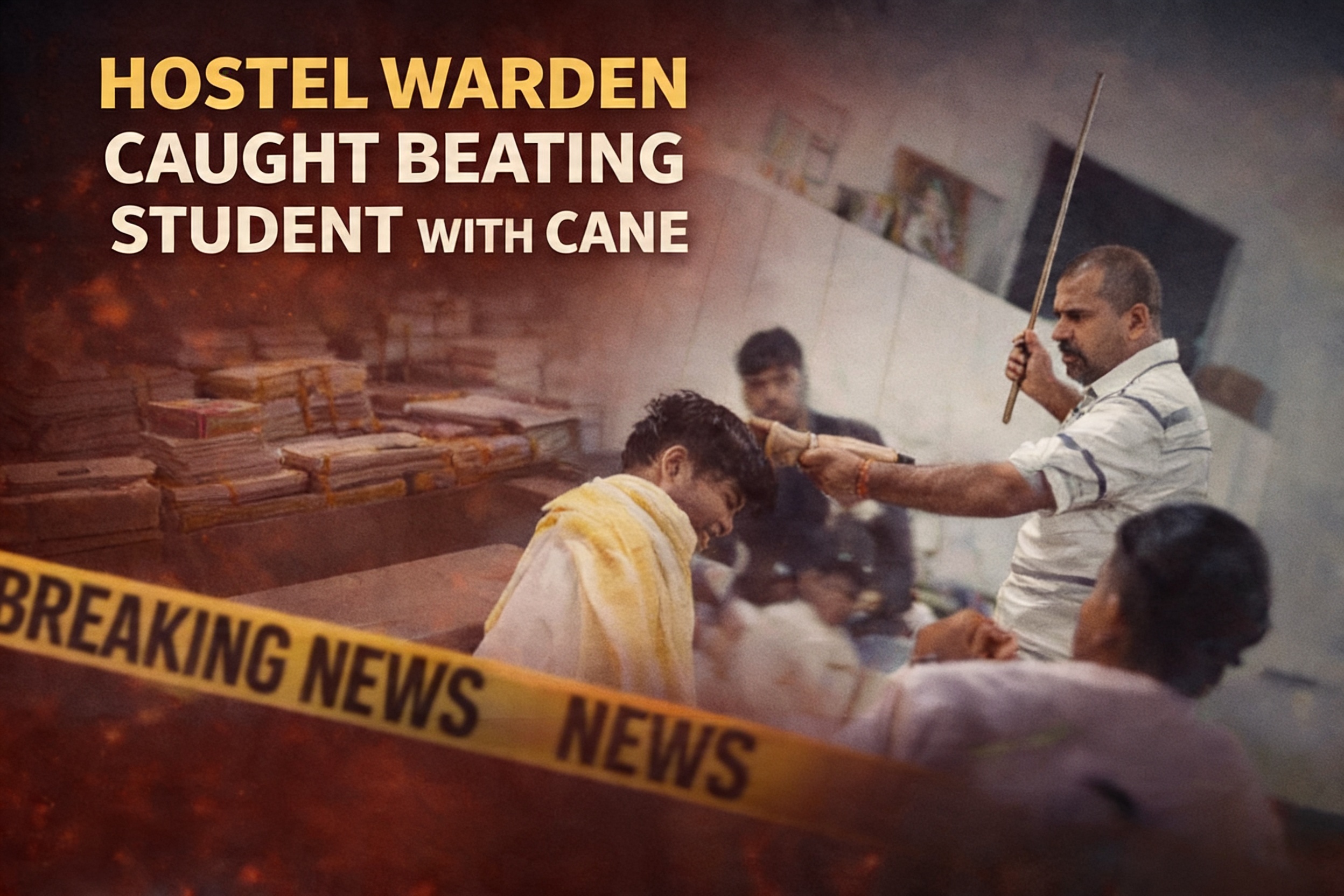
A hostel warden at Maharshi Sandipani Rashtriya Veda Vidya Pratishthan struck a minor student repeatedly with a wooden stick over a trivial dormitory dispute. Action came only after the footage spread across social media. The question is why it took a viral video to move the system.
By NewsRevolt India Desk | Published: April 18, 2026 | Ujjain, Madhya Pradesh
On the night of March 15, 2026, a minor student at one of India’s most prominent government-linked Vedic institutions made the kind of mistake that any tired child might make. He went to sleep in a room that was not his assigned one, and settled into a bed that belonged to another student.
What followed was not a quiet correction or a verbal reprimand. At approximately 10 PM, hostel warden and teacher Dattadas Raghunath Shewde was informed of the lapse. He summoned the boy from the room, verbally abused him with obscene language in the corridor, marched him to the hostel office, and beat him repeatedly with a wooden stick while the child cried out in pain and begged for the assault to stop.
Other adults were present throughout. Not one intervened.
For six days, the incident remained within the walls of Maharshi Sandipani Rashtriya Veda Vidya Pratishthan on Chintaman Road, Ujjain. It might have stayed there permanently, were it not for a 44-second video clip that reached social media on March 21.
What the Video Shows
The footage, recorded by someone present in the room, is unambiguous. Shewde is seen striking the student multiple times with a cane while questioning him about the bed. The child can be heard screaming and pleading with the warden to stop. Other students in the room sit frozen. No teacher, no staff member, no adult steps forward to pull Shewde back or shield the boy.
The clip spread rapidly across platforms and generated immediate national outrage. What it documented was not a moment of temper that escalated unexpectedly. It was a sustained, deliberate assault on a minor child carried out openly, in the presence of witnesses, by a man in a position of complete institutional authority over his victims.
The Institution and Why It Matters
Maharshi Sandipani Rashtriya Veda Vidya Pratishthan is not an obscure private school. It operates directly under the aegis of the Union Ministry of Education and is among India’s most recognised Gurukul-style residential Vedic institutions. Students from across the country live on campus to pursue traditional Vedic studies, following a disciplined daily routine that includes pre-dawn prayers and the strict observance of institutional rules. The institution’s stated mission is to preserve and transmit India’s ancient Vedic heritage.
The fact that this assault occurred inside such an institution, one funded and overseen by the central government, is not incidental to the story. It is central to it. If structured oversight and government accountability cannot prevent the beating of a child over a dormitory dispute at a nationally prominent institution, the question of what happens inside the hundreds of smaller, unregulated residential schools and gurukuls across India becomes deeply uncomfortable.
Timeline: Action Only After Outrage
The sequence of events following the incident reveals a pattern that recurs with striking regularity in cases of institutional child abuse across India.
The assault took place on March 15. For six days, the institution took no visible action. The video surfaced on March 21. The same day it went viral, the institution quietly accepted what it described as Shewde’s resignation application. A probe was announced.
On March 22, the student visited Chintaman Police Station accompanied by his teacher Satyam Shukla and filed a verbal complaint. An FIR was registered against Shewde under Sections 115 and 296 of the Bharatiya Nyaya Sanhita and Section 75 of the Juvenile Justice Act, which specifically addresses cruelty to children. Shewde appeared at the police station the same night and was arrested. He was produced before a district court and granted bail of Rs 25,000.
The pattern is not subtle. An assault took place on March 15. An FIR was registered on March 22, seven days later and only after a video forced public accountability. The institution’s internal response, accepting a resignation rather than initiating a formal inquiry, suggests the default instinct was containment rather than accountability.
The Normalisation That the Video Exposed
Chintaman Police Station in-charge Hemraj Yadav confirmed that Shewde had served as the hostel warden in the Samaveda Ranayaniya branch of the institution. A warden’s role is specifically to ensure the safety and welfare of students residing in the hostel.
That this man felt comfortable enough to beat a child in an office, in front of others, without apparent hesitation or concealment, suggests that the use of physical force as a disciplinary tool was not treated as unusual or prohibited within that environment. The presence of bystanders who did not intervene is not simply a failure of individual courage. It reflects an institutional culture in which corporal punishment is sufficiently normalised that witnesses do not experience it as an emergency requiring intervention.
Corporal punishment has been explicitly prohibited in Indian schools under the Right to Education Act and multiple Supreme Court rulings. Its continued practice in residential institutions, particularly those with limited external oversight, is not a secret. It is an open and chronic failure of enforcement.
What This Costs Children
Physical punishment of the kind documented in this video does not end when the beating stops. Research across child development and psychology consistently documents that children subjected to corporal punishment in institutional settings experience lasting damage: elevated anxiety and fear responses, erosion of trust in authority figures, deterioration of academic engagement, and in severe cases, symptoms consistent with post-traumatic stress. The child in this video was beaten, humiliated in front of peers, and forced to relive the experience publicly when the video circulated nationally. The institution that was supposed to educate and protect him failed him at every stage.
A System That Responds to Cameras, Not Children
The Ujjain incident is not an isolated case. It is a data point in a long and largely unaddressed national pattern. India bans corporal punishment. India continues to practice it. The gap between the law and its enforcement in residential educational institutions, particularly in rural and semi-urban areas, is wide enough to allow years of abuse to continue in plain sight.
What changed on March 21 was not the law, not the institution’s internal procedures, and not the police’s awareness of child protection provisions. What changed was that a camera captured 44 seconds of footage and a social media platform made it impossible to ignore.
Dattadas Shewde has been arrested. He has been dismissed. He is out on bail. The child he beat is left to carry whatever this experience has given him.
The institution remains open. The system that allowed this to happen, and that required a viral video to produce a seven-day-delayed FIR, remains largely unchanged.
Until accountability in India’s residential schools and gurukuls becomes a matter of routine rather than a response to public outrage, the question posed by this incident will keep returning: if a child is not safe inside a government-linked Vedic institute, where exactly is he safe?
— NewsRevolt India | newsrevolt.in
Reported by the NewsRevolt Desk. Facts sourced from Chintaman Police Station, Times of India, Republic World, Free Press Journal, Economic Times Education, and National Herald India. Published April 18, 2026.