



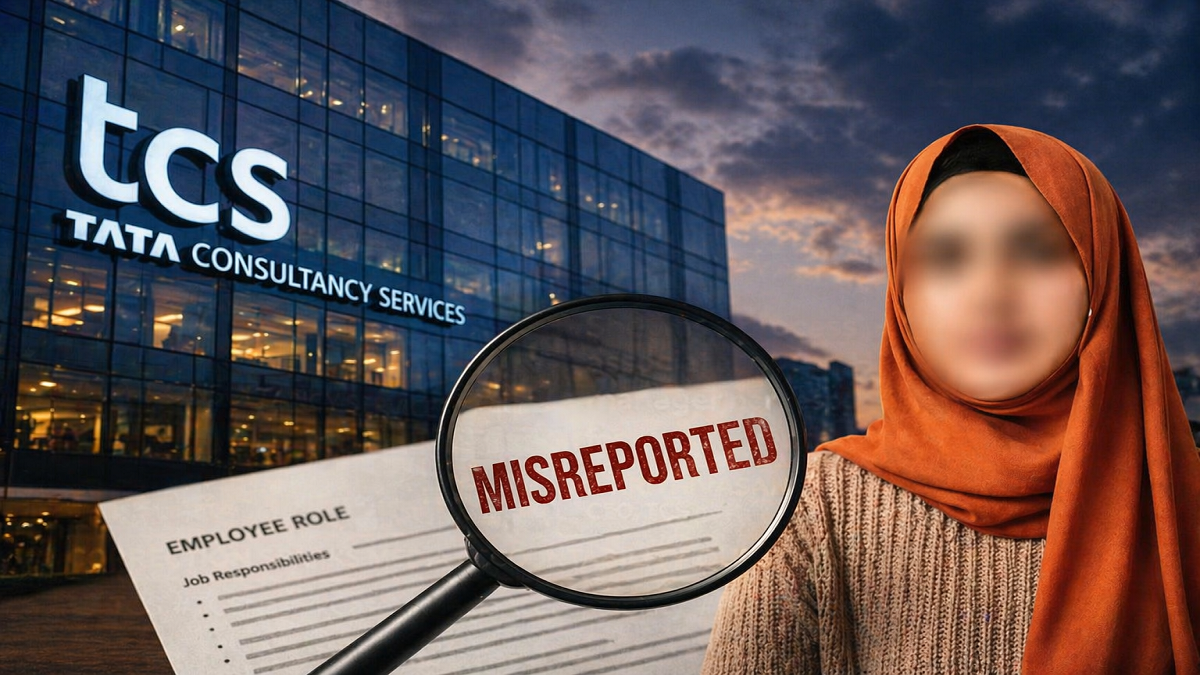
TCS officially confirmed that Nida Khan was not an HR manager, not responsible for recruitment, and held no leadership role. A key public claim, repeated by major news outlets, has been formally contradicted by the company itself.
By NewsRevolt India Desk | Published: April 21, 2026 | Nashik, Maharashtra
A significant correction has arrived in the TCS Nashik case, and it came not from a fact-checker or a rival outlet, but from Tata Consultancy Services itself.
In an official statement, TCS CEO K. Krithivasan confirmed that Nida Khan, the accused at the centre of the Nashik controversy, was a process associate. She was not an HR manager, not responsible for recruitment, and held no leadership position within the organisation.
That is a consequential clarification. For days, across television channels and digital news platforms, Nida Khan had been repeatedly identified as an HR manager and in several instances an HR head at TCS Nashik. That label was not incidental to the reporting. It was central to how the story was constructed and how public outrage around it was sustained.
A Designation That Defined the Narrative
The difference between a process associate and an HR manager is not a matter of nuance. It is a matter of institutional authority.
An HR manager carries responsibility over recruitment decisions, employee grievances, internal policy, and formal escalation channels. The label HR head suggests even wider reach, the kind of organisational power that can shape workplace culture, protect certain employees, and selectively manage complaints. When news outlets repeatedly applied that description to Nida Khan, they embedded into the public mind a specific assumption about how far her influence inside TCS extended.
TCS has since stated, on the record, that this assumption was factually incorrect.
A wrong designation in a high-voltage case does not simply misrepresent one individual. It distorts the public understanding of how the alleged events were possible, how much institutional cover may have existed, and where accountability should be directed. All of that was built, at least in part, on a label that TCS has now formally disputed.
The Responsibility That Was Abandoned
India’s mainstream media did not merely report on the TCS Nashik case. It shaped the national narrative around it. Prime-time programmes, viral graphics, and bold newspaper subheadings repeated the same designation, hour after hour, day after day, until it became indistinguishable from established fact.
That is not journalism. That is amplification without verification.
The standard required was not a complex investigative procedure. It was a single step: contact TCS and confirm the accused employee’s actual designation and role before broadcasting it to millions. That step was either not taken or not taken in time. When TCS eventually provided its clarification publicly, the correction received a fraction of the coverage the original claim had generated.
In cases carrying communal sensitivity and legal consequence, this kind of reporting failure is not a footnote. It is a systemic problem with real and lasting effects on public opinion, individual reputations, and social cohesion. Mainstream media must be held to a higher standard of responsibility, particularly when the stories they choose to amplify are charged with the potential to deepen divisions.
What TCS Has Done
TCS has not walked away from the Nashik matter. The company confirmed that its Nashik unit continues to operate, and that an independent review has been initiated with external support from Deloitte and Trilegal. The company also stated that no complaints were received through internal POSH channels, a detail that raises its own questions about the timeline of allegations.
Staff named in the case have been suspended. TCS’s institutional response has been structured, transparent, and calibrated. That response stands in notable contrast to the environment created by coverage that preceded it.
The Question That Remains
India does not lack frameworks for responsible journalism. What it consistently lacks is accountability when those frameworks are ignored in pursuit of audience engagement.
In the TCS Nashik case, an unverified occupational label travelled faster and louder than the company’s eventual correction. By the time TCS spoke clearly, the narrative had already taken root in public consciousness.
Media misinformation does not always begin with fabrication. It frequently begins with an unverified claim repeated uncritically in a story designed to provoke rather than inform. The audience is left believing it has been told the facts, when it has in reality been handed a framing.
TCS has clarified the record. The media organisations that built a national story on an inaccurate description now owe their audiences the same honesty.
By NewsRevolt India Desk | newsrevolt.in
Sources: TCS official statement, TCS CEO K. Krithivasan, People Matters, Business Today, The Hindu. Published April 21, 2026.