



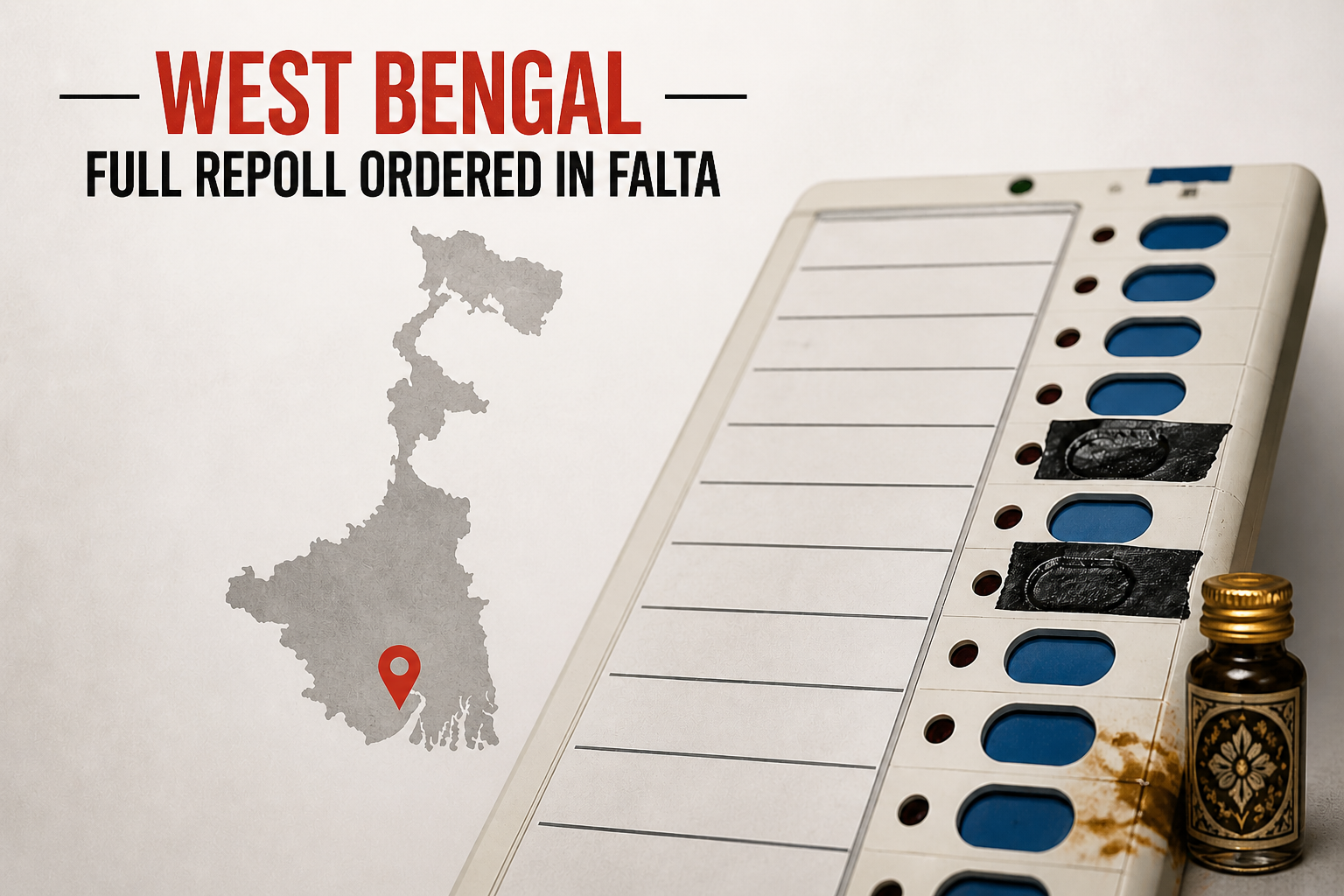
The Election Commission of India has taken the rare and extraordinary step of ordering a complete repoll across all 285 polling stations of the Falta Assembly Constituency in West Bengal, citing “severe electoral offences” and “subversion of the democratic process” during Phase 2 voting on April 29, 2026. Fresh polling is scheduled for May 21, with counting on May 24.
By NewsRevolt India Desk | Published: May 3, 2026 | Kolkata / New Delhi
It is one of the rarest decisions the Election Commission of India can make. Ordering a repoll in an entire assembly constituency — not a handful of booths, but every single one of its 285 polling stations — requires the Commission to be satisfied that the democratic process was not merely compromised at the margins, but fundamentally subverted at scale.
On May 2, 2026, that is exactly what the Election Commission said had happened in Falta.
What the Election Commission Found
The ECI’s official order was unambiguous in its language: “On consideration of severe electoral offences and subversion of the democratic process during the polling in a large number of polling stations on April 29, 2026 in 144-Falta Assembly Constituency, West Bengal, the Commission directs that fresh poll shall be conducted in all 285 polling stations, including auxiliary polling stations.”
Fresh polling will be held on May 21, 2026, from 7 AM to 6 PM. The counting of Falta’s votes will take place on May 24 — days after the rest of West Bengal counts its results.
The Specific Offences: EVM Tampering, Intimidation, and Identity Surveillance
The ECI had received at least 77 complaints linked to EVM tampering across Phase 2 polling. Several of the most alarming methods were documented specifically at Falta and neighbouring constituencies.
In a number of booths, the buttons of specific political parties on electronic voting machines were covered with adhesive tape or deliberately darkened with ink, physically preventing voters from selecting certain candidates.
In what The Hindu described as a particularly sophisticated form of electoral manipulation, attar — a traditional perfume — was applied to EVM buttons of specific parties. Any voter who pressed those buttons would carry the scent on their fingers, allowing party cadres positioned outside to identify exactly how individuals had voted.
Beyond EVM tampering, the Commission noted illegal presence of political party cadres inside polling stations, instances of companions voting on behalf of electors, and missing video surveillance footage from several booths.
Violence, Protests, and Road Blockades
The electoral malpractice in Falta did not occur in silence. It was accompanied by violence on the ground that forced the Commission’s hand.
Residents staged protests on polling day and the day after, blocking sections of the national highway and demanding that their votes be protected. Allegations of threats of violence and arson by a candidate’s associates circulated widely on social media.
Both TMC and BJP accused each other of voter intimidation and vote tampering, as political tensions turned NH-blocked roads into a symbol of democratic frustration.
The Election Commission had already ordered repolling in 15 booths across Diamond Harbour and Magrahat Paschim constituencies on May 1 over similar EVM-related complaints, before taking the far larger step of ordering a full repoll in Falta on May 2.
Why This Decision Matters Beyond Falta
A full constituency repoll is extraordinarily rare in Indian electoral history. The Commission’s willingness to invoke it in Falta sends a message that has implications well beyond South 24 Parganas.
It confirms that the mechanisms of electoral fraud being deployed in West Bengal in 2026 are not petty irregularities but systematic, pre-planned operations designed to eliminate voter choice at scale. Covering EVM buttons with adhesive tape is not spontaneous. Applying attar to specific party buttons to track individual voter choices requires prior planning, materials, and coordination inside polling booths.
It also raises a question the political establishment of West Bengal — and specifically the ruling Trinamool Congress, which has governed the state for over a decade — must answer publicly: how did these materials reach polling booths that were supposed to be under the supervision of presiding officers and central forces?
The Election Commission has deployed additional observers for the May 21 repoll and has tightened security arrangements across all 285 stations.
What Voters in Falta Are Owed
The voters of Falta Assembly Constituency have already been to their polling stations once. They were turned away, manipulated, tracked, or intimidated. Some had their votes physically blocked by tape on a machine.
They will now be asked to vote again on May 21. The least the state of West Bengal, the political parties contesting the seat, and the administration managing the polls can do is ensure that what happened on April 29 does not happen again.
The Election Commission’s order is a correction. It is not a guarantee. The guarantee must be delivered on the ground, by presiding officers, security personnel, and a political culture that treats voter rights as non-negotiable rather than as an obstacle to managing outcomes.
By NewsRevolt India Desk | newsrevolt.in