


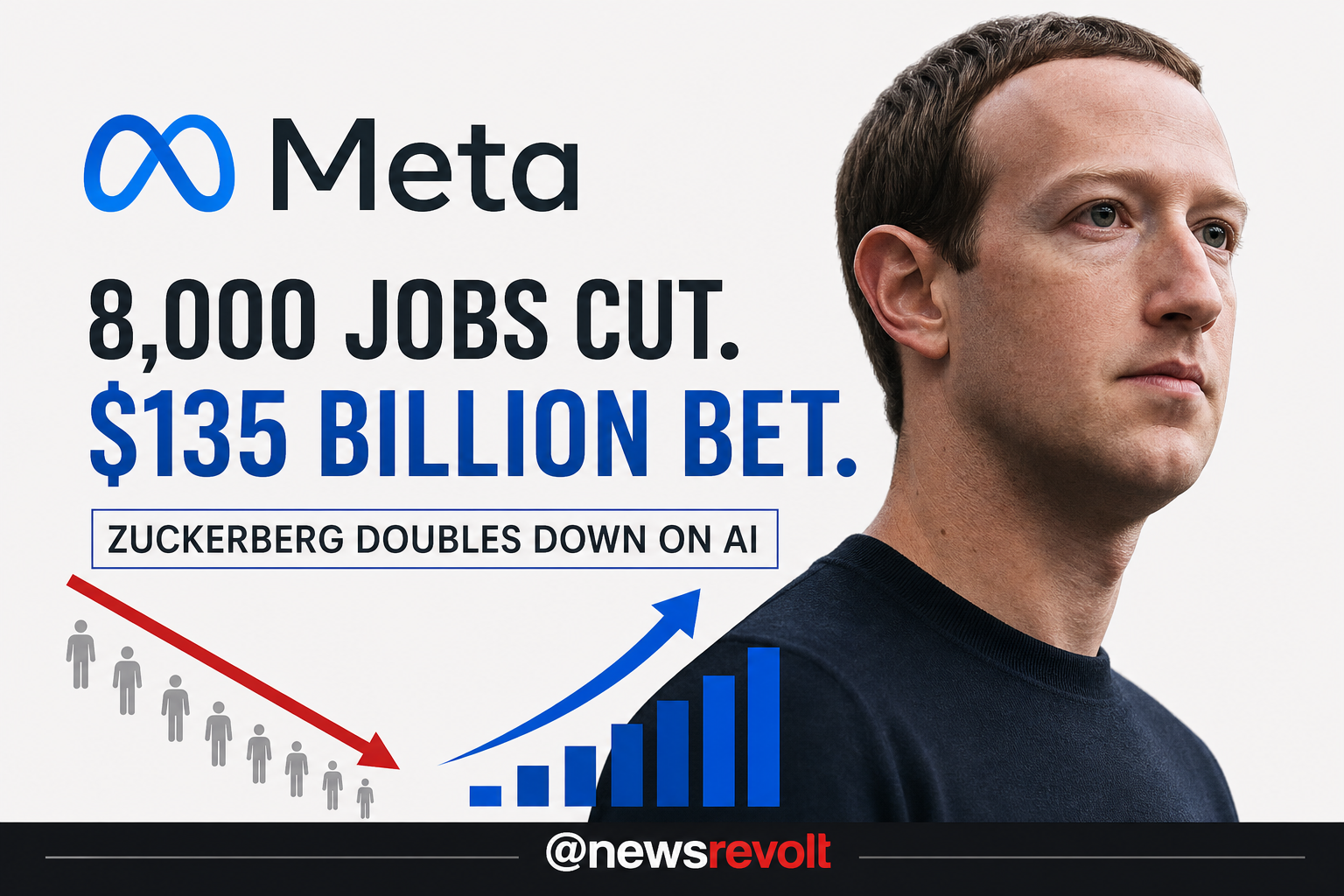
Meta Platforms has confirmed it will lay off approximately 8,000 employees — 10 percent of its global workforce — on May 20, 2026, while simultaneously raising its full-year AI capital expenditure guidance to between $125 billion and $145 billion. Mark Zuckerberg’s explanation was candid and cold: “If we invest more in one area, we have less capital for others.”
By NewsRevolt India Desk | Published: May 1, 2026 | San Francisco / New Delhi
Meta Platforms, the company that owns Facebook, Instagram, and WhatsApp, is cutting 8,000 jobs. It is also planning to spend more money in 2026 than it has ever spent in a single year — more, in fact, than it spent on AI infrastructure in the entire three years of 2023, 2024, and 2025 combined.
Both of those facts are true simultaneously. And understanding why requires understanding what Mark Zuckerberg is betting the company on, and what he is willing to sacrifice to win that bet.
The Layoff: What Is Confirmed
Meta’s Chief People Officer Janelle Gale sent an internal memo to employees on April 23, 2026, confirming that the company would lay off approximately 10 percent of its global workforce — around 8,000 employees — effective May 20, 2026.
The memo also confirmed that Meta would simultaneously close approximately 6,000 open roles that had been advertised but not yet filled. Together, the cuts represent the largest workforce reduction at Meta since 2023.
Severance terms for US-based employees: 16 weeks of base pay, plus an additional two weeks for every year of service.
Zuckerberg addressed the layoffs directly in an internal town hall, where he was unusually candid about the logic behind them. “If we’re investing more in one area to serve our community, then that means we have less capital to allocate to the other. So that means we do need to take down the size of the company somewhat,” he said.
He added that the layoffs were unrelated to Meta’s recent internal reorganisation and were not a consequence of the AI agent rollout that is gradually automating certain tasks within the company.
The Spending: What Zuckerberg Is Building
The reason Meta is cutting staff is also the reason its stock slid six percent after earnings: the company is spending at a scale that has unnerved even its most loyal investors.
Meta raised its full-year 2026 capital expenditure guidance to between $125 billion and $145 billion — up from a previous range of $115 billion to $135 billion.
To put that number in perspective: $135 billion in a single year is roughly equal to everything Meta spent on AI infrastructure across 2023, 2024, and 2025 combined.
The increase was driven by two factors: higher component costs — specifically memory pricing — and additional data centre costs to support what Zuckerberg described as “future-year capacity.”
The capital is being deployed toward three interconnected priorities. First, a Superintelligence AI lab, which Zuckerberg says has built “the strongest research team in the industry” over the past ten months and recently released a “significantly upgraded” version of Meta AI. Second, custom silicon developed in partnership with Broadcom, with over one gigawatt of Meta’s own chips being rolled out alongside AMD and Nvidia infrastructure. Third, data centre expansion at a scale designed to support what Zuckerberg envisions as a “personal superintelligence” layer embedded across Meta’s three-billion-user social media ecosystem.
The Strategic Context: A Race Meta Cannot Afford to Lose
Zuckerberg has been explicit about his competitive framing. Meta is in a direct race against OpenAI, Google DeepMind, and Anthropic to establish dominance in the next generation of AI.
That race is not abstract. It has direct implications for Meta’s core business model. Facebook and Instagram generate revenue primarily through advertising. Advertising relevance and targeting depend increasingly on AI model quality. A Meta that falls behind in foundational AI capability is a Meta whose advertising business becomes less competitive over time.
Zuckerberg described 2026 as “the year of AI” for Meta in an internal memo earlier this year, and the capital allocation decisions being made now reflect a belief that the next two to three years will determine which companies establish themselves as AI leaders and which fall permanently behind.
The Human Cost and the Surveillance Controversy
The 8,000 employees losing their jobs are not abstractions in Zuckerberg’s capital allocation equation. They are engineers, designers, marketers, and operations staff who built products used by three billion people. The severance packages are generous by industry standards, but the structural message is clear: human labour is the variable cost that gets reduced when infrastructure investment increases.
The layoffs have also been accompanied by a separate controversy inside Meta: reports that the company has been monitoring employee activity through surveillance of mouse movements and keystrokes, tracking how actively staff engage with internal tools. That practice has generated significant internal backlash from employees who describe it as an atmosphere of distrust at exactly the moment the company is asking remaining staff to deliver what Zuckerberg called “outsized impact.”
What Investors Are Watching
Meta’s stock fell six percent following the earnings call, despite the company reporting strong first-quarter 2026 revenue.
Investors are watching for two things that Zuckerberg has not yet been able to provide with precision. First, a clear monetisation pathway for the AI investments beyond improved advertising targeting. Second, measurable evidence that Meta AI is gaining user engagement at scale comparable to ChatGPT or Gemini.
Zuckerberg acknowledged during the investor call that Meta does not have “a very precise plan for exactly how each product is going to scale month over month,” but expressed confidence in the direction of travel. “I’m quite comfortable that the lab we’re building is on track to be a leading lab in the world,” he said.
That confidence may be well-founded. It may also reflect the kind of founder certainty that has historically preceded both Meta’s greatest successes — and its most expensive course corrections.
The Bottom Line
Zuckerberg’s quote — “If we invest more in one area, we have less capital for others” — is both a business statement and an ideological one. It reflects a view of Meta’s future in which AI infrastructure is the primary asset, human workforce is a secondary cost, and the competitive race against OpenAI and Google is existential rather than optional.
Whether the $135 billion bet pays off will determine whether Meta’s 2026 restructuring is remembered as Zuckerberg’s boldest strategic pivot — or his most costly miscalculation.
By NewsRevolt India Desk | newsrevolt.in