



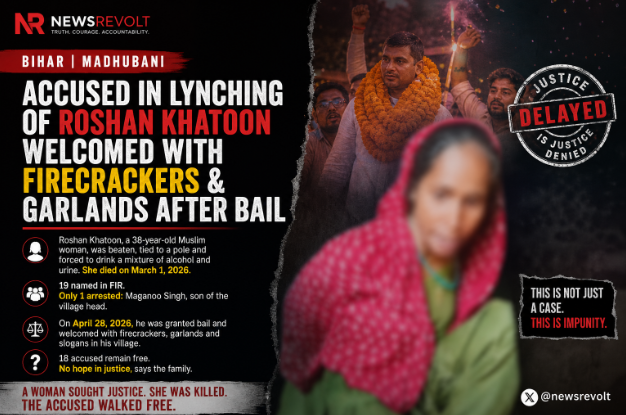
Roshan Khatoon, a 38-year-old Muslim woman from Madhubani, Bihar, was tied to a pole, beaten by a mob, and forced to drink a mixture of alcohol and urine while fasting during Ramadan. She died the next day. Two months later, the only arrested accused is free on bail — and was welcomed home with garlands, colours, and the slogan “Maganoo Singh Zindabad.”
By NewsRevolt India Desk | Published: May 1, 2026 | Madhubani, Bihar
She had gone to her village head for help.
Roshan Khatoon, a 38-year-old Muslim woman from Amhi village in Ghoghardiha, Madhubani district, had a local land dispute she could not resolve on her own. On February 28, 2026, during the holy month of Ramadan, she walked to the home of the village head to seek mediation. She was fasting. She carried no weapon. She posed no threat.
What happened in that village, in front of witnesses, stands as one of the most documented and least prosecuted acts of communal violence in Bihar in recent memory — and the events of April 28, 2026, made it worse.
What Was Done to Roshan Khatoon
According to eyewitness testimony reported by The Quint and corroborated by Maktoob Media, Roshan Khatoon was surrounded by a mob led by Maganoo Singh, the son of the very village head she had approached for help.
She was tied to a pole. She was beaten severely. When she screamed in pain and begged for water, her attackers reportedly forced her to drink a mixture of alcohol and urine instead.
Her husband, Mohammad Shahabuddin, described the family’s despair: “She had gone there to ask for justice. Instead of listening to her, they beat her to death.”
Roshan was rushed to Patna Medical College and Hospital. She died on March 1, 2026 — the day after the attack.
She had done nothing except ask for help.
One Arrest. Eighteen Free. Two Months of Silence.
An FIR was registered naming 19 accused in Roshan Khatoon’s killing.
In the two months that followed, Bihar Police arrested exactly one person: Maganoo Singh, the village head’s son who allegedly led the mob. The remaining 18 named accused have not been arrested. No public explanation has been offered by Bihar Police or the state government for why 18 individuals named in an FIR for a lynching death remain free.
Roshan Khatoon’s family told reporters they have “no hope in the justice system.”
That is not a complaint. It is a verdict — delivered not by a court, but by two months of institutional indifference.
The Bail. The Celebration. The Slogan.
On April 28, 2026, a court granted Maganoo Singh bail.
When he returned to his village in Madhubani, there were no quiet homecomings, no lowered heads. There were firecrackers. Garlands. Colours. Celebrations. And the slogan “Maganoo Singh Zindabad” — Long Live Maganoo Singh — echoing through the village as residents and supporters welcomed him back as a returning hero.
The woman he is accused of killing had been fasting in devotion when she was beaten to death. The man accused of beating her was celebrated with the kind of reception reserved for victorious athletes and political leaders.
That celebration was not a private family matter. It was a public, filmed, and widely shared event. It sent a message to every Muslim resident of Madhubani, and every minority citizen watching from across India, about who the system protects and who it celebrates.
The Law That Exists — and the Law That Is Enforced
India’s Supreme Court, in its landmark 2018 Tehseen Poonawalla judgment on mob lynching, gave detailed directions to every state government: designate Nodal Officers for lynching prevention, enact specific anti-lynching legislation, fast-track trials in such cases, and ensure exemplary punishment to deter future mob violence.
Bihar has not enacted specific anti-lynching legislation.
No fast-tracked trial has been announced in Roshan Khatoon’s case. The only arrested accused walked free in less than two months. Eighteen others named in the FIR have never been charged before a court.
The Supreme Court’s own directions — issued eight years ago — remain, two months after Roshan’s death, effectively unenforced in Madhubani district.
The Accountability That Is Owed
Roshan Khatoon was killed in broad daylight, in front of witnesses, in a village in one of India’s most populous states, during the most sacred month in the Islamic calendar.
The state of Bihar owes her family, and the public, direct answers to three questions that have gone unanswered for two months.
Why have 18 of 19 named accused not been arrested despite a registered FIR? Why was bail granted to the only arrested accused when the co-accused remain free and the trial has not begun? And what action, if any, will the state government take against those who publicly celebrated the release of a lynching accused with firecrackers and slogans?
These are not rhetorical questions. They are the minimum that justice requires.
Roshan Khatoon went to her village head seeking help. She was killed for it. The least the state of Bihar can do now is ensure that the 19 people named in her FIR face a court — and that no one celebrates their freedom again until a judge says they have earned it.
By NewsRevolt India Desk | newsrevolt.in