



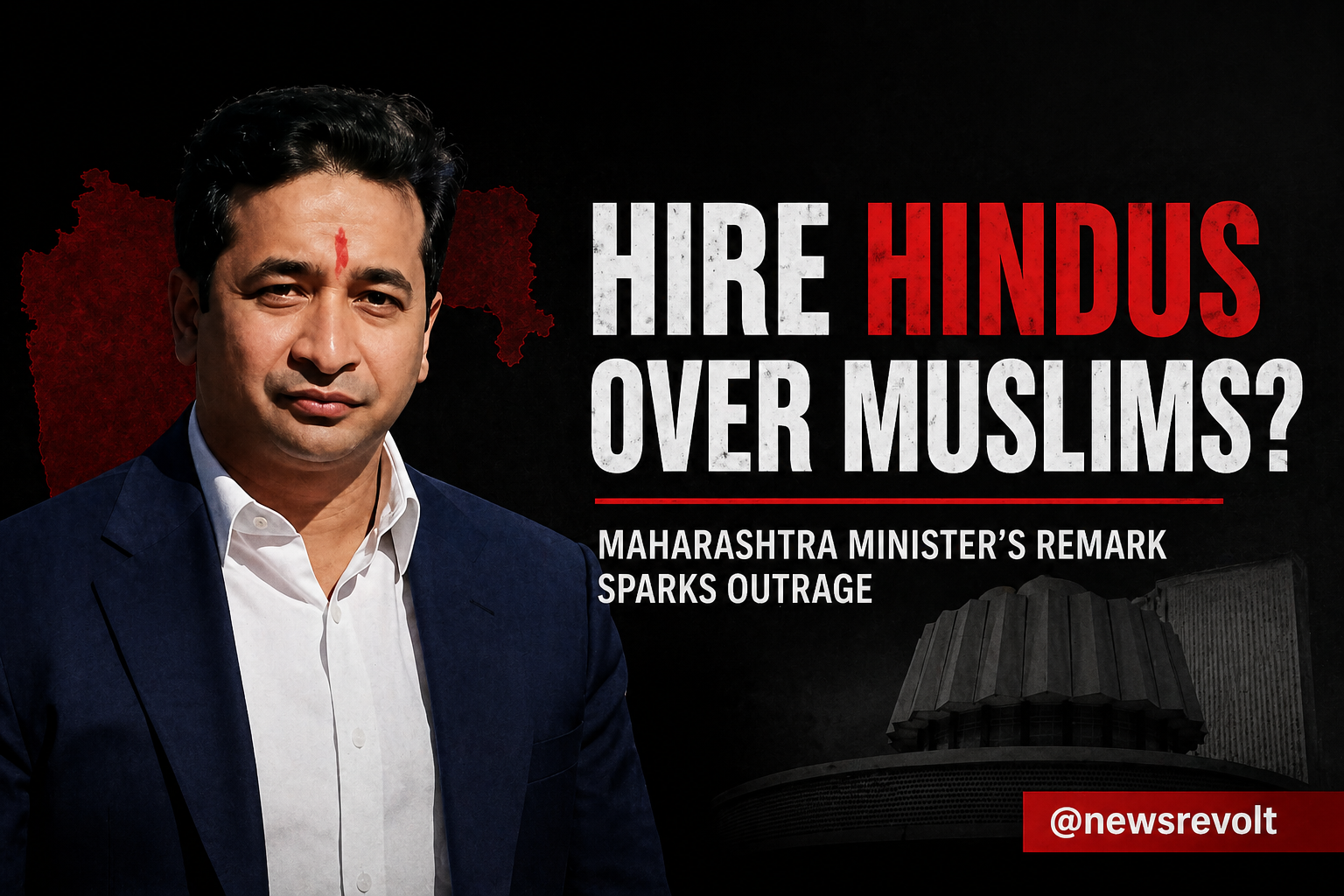
BJP minister and Maharashtra fisheries minister Nitesh Rane called for preferential hiring of Hindu candidates in corporate India, building his argument on the unresolved TCS Nashik case. The statement has triggered a major political storm and raises direct constitutional questions.
By NewsRevolt India Desk | Published: April 25, 2026 | Mumbai, Maharashtra
A sitting Maharashtra cabinet minister has publicly called for companies to prioritise Hindu candidates in hiring to prevent what he described as “corporate jihad.” The statement, made on April 15, 2026, by BJP leader and fisheries minister Nitesh Rane, has drawn swift political backlash, constitutional scrutiny, and questions about the factual basis on which it was built.
Rane told reporters: “If employment provided for livelihood is diverted towards religious conversion, then prioritising Hindu candidates is the need of the hour to strengthen the Hindu rashtra.” He warned that companies may soon adopt policies of hiring exclusively Hindu candidates to prevent what he called “jihadist activities” in corporate spaces.
What Rane Said and What Triggered It
Rane’s remarks were directly linked to the TCS Nashik case, in which eight employees of a Tata Consultancy Services BPO unit were arrested following allegations of sexual harassment and alleged attempts at religious conversion.
The minister alleged that employment was being used as a tool for religious conversion across Maharashtra, and that a sentiment was growing within the Hindu community to conduct economic transactions and employment exclusively with fellow Hindus.
“If every platform, from trade to corporate offices, is used to target Hindus through various forms of jihad, it is time for a firm response,” Rane said. He added that the community should not wait for the state to act and that religious considerations in hiring were now a practical necessity.
This was not an isolated voice. Maharashtra Chief Minister Devendra Fadnavis had already used the phrase “corporate jihad” in his own public remarks on the Nashik case, framing it alongside references to “love jihad” and “land jihad.” When both the Chief Minister and a cabinet minister employ the same unverified framing in quick succession, the language ceases to be one politician’s opinion and begins to function as state-level narrative.
The Constitutional Problem With the Statement
India’s Constitution is unambiguous on this point. Article 16 guarantees equality of opportunity in matters of public employment and explicitly prohibits discrimination on grounds of religion, race, caste, sex, or place of birth. While Article 16 directly applies to state employment, the broader constitutional values of Articles 14, 15, and 16 together establish a framework that makes religion-based exclusion in any organised employment setting legally and ethically untenable.
No statute in India permits private sector employers to filter candidates on religious grounds. A minister publicly endorsing such a practice, even framed as a community sentiment rather than a formal policy directive, carries weight precisely because of the office from which it is made.
The Citizens for Justice and Peace, in its published analysis of the Nashik case, noted that “when narratives outpace evidence, investigations can be distorted by public pressure, due process may be compromised, and entire communities may be subjected to collective suspicion.” Rane’s statement exemplifies exactly that dynamic.
The Factual Foundation Was Shaky
The critical context surrounding Rane’s remarks is that they were built on a case whose most prominent public claims had already been formally challenged.
By April 17, 2026, TCS CEO K. Krithivasan had confirmed on record that a central figure in the case was a process associate, not an HR manager, and held no leadership role within the company. The company stated it had received no POSH complaints through internal channels, and had initiated an independent review involving Deloitte and Trilegal.
In other words, a cabinet minister demanded religion-based hiring across Maharashtra’s corporate sector based on a case in which the foundational public claims were still being actively corrected by the company at the centre of the allegations.
The Political Fallout
The statement did not go unchallenged within Maharashtra’s own political landscape. Shiv Sena (UBT) accused the ruling BJP of reducing a serious case of workplace harassment to a communal wedge, and pointed to what it called selective outrage: similar urgency and political framing had been absent when accused individuals in other harassment cases had belonged to Hindu communities.
Rane himself is not a first-time controversialist. He was booked in 2024 for a threatening speech targeting Muslims during a rally in Yeola. His record provides additional context for assessing the political intentions behind his April 2026 remarks.
The Broader Risk
Individual criminal cases, however serious, do not automatically establish systemic patterns applicable to an entire religion. The eight TCS Nashik arrests are a law enforcement matter that warrants rigorous investigation and full judicial process.
What it does not warrant, on the available evidence, is a serving minister calling for religion-based exclusion in employment across an entire state’s corporate sector. That is not a response to crime. It is the exploitation of a criminal case to advance a political and ideological objective that sits in direct conflict with India’s constitutional architecture.
That distinction must be stated clearly and stated often. Maharashtra’s corporate workforce, its employees across every community, and the Constitution they work under all deserve better than this.
By NewsRevolt India Desk | newsrevolt.in