



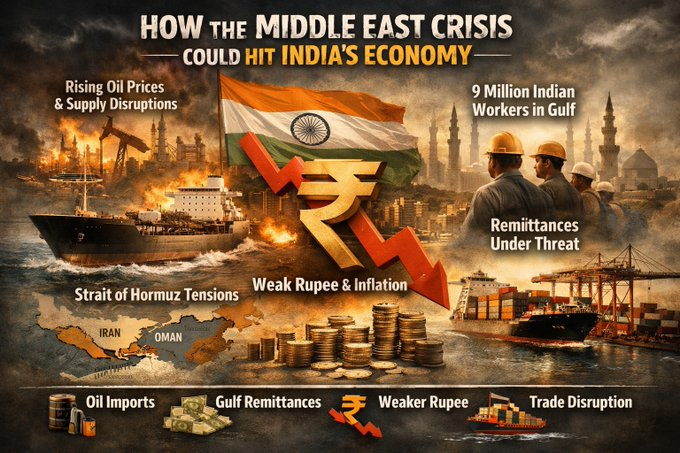
India imports approximately 85 percent of its crude oil and over 80 percent of its LPG from or through the Middle East. As conflict in West Asia escalates in 2026, the consequences are moving well beyond geopolitics — they are arriving at India’s petrol pumps, kitchen cylinders, factory floors, and family budgets.
By NewsRevolt India Desk | Published: April 26, 2026 | New Delhi
When conflict erupts in West Asia, it does not stay in West Asia. For a country as structurally dependent on Middle Eastern energy as India, every escalation in the Gulf translates into a measurable cost — in crude prices, in inflation, in currency pressure, and in the income of millions of families with a member working abroad.
The 2026 Iran war has made this dependency impossible to ignore. India is now navigating what former Chief Economic Adviser Arvind Subramanian has described as a potential “stagflationary shock of considerable magnitude” — a scenario in which inflation rises while economic growth stalls simultaneously.
The Energy Dependency That Makes India Vulnerable
India is the world’s third-largest consumer of crude oil. It imports approximately 85 percent of its total crude requirements, and as of early 2026, roughly 55 percent of those imports come from Middle Eastern nations including Iraq, Saudi Arabia, the UAE, and Kuwait.
The LPG exposure is even more concentrated. India imports approximately 60 percent of its LPG consumption, and 90 percent of those imports historically passed through the Strait of Hormuz — the narrow waterway between Iran and Oman through which approximately 20 percent of the world’s total oil trade flows.
When US and Israeli military operations against Iran triggered the effective closure of the Strait of Hormuz in early March 2026, India’s functional vulnerability became operational reality overnight. QatarEnergy declared force majeure. Shipping insurance premiums surged over 1,000 percent. Tanker operators withdrew from Gulf routes. India, which had assumed 25 to 30 days of LPG buffer, found its real working stock closer to ten days.
The Price Spiral That Follows Every Supply Shock
The mechanism through which Middle East disruptions reach Indian households is well established and moves quickly.
Rising crude prices push up the cost of petrol and diesel. Higher transport costs feed into the price of every good that moves by road, which in India means almost everything. Food prices rise. Manufacturing input costs increase. Energy-intensive industries including ceramics, chemicals, fertilizers, and food processing face direct cost pressure.
In the current crisis, Brent crude, which was trading at approximately $69 per barrel in February 2026, surged above $110 by mid-March and has remained elevated since. Analysts at Capital Economics have warned that spikes above $120 per barrel could cut global GDP by up to one percentage point. For India specifically, the conflict is projected to reduce GDP growth by up to one full point in the current financial year, while pushing inflation up by an additional 1 to 1.5 percentage points.
The Reserve Bank of India has already signalled caution, holding rates amid the uncertainty rather than moving to cut them as had been expected earlier in the year.
The Rupee Under Pressure
Every dollar spent on oil imports is a dollar that must be sourced from foreign exchange reserves. When oil prices rise sharply, India’s import bill expands, demand for US dollars increases, and the rupee comes under sustained downward pressure.
The Rupee weakened to approximately 94 against the US dollar by late March 2026 — a level that compounds the cost of every barrel and every LNG shipment India contracts internationally.
A weaker rupee is not only an abstract monetary concern. It raises the cost of all imported goods, from electronic components to pharmaceuticals to industrial machinery, feeding back into broader inflation pressures that ultimately reach consumers.
NITI Aayog, in its quarterly Trade Watch report, has explicitly flagged that Middle East instability is putting pressure on India’s current account deficit and exchange rate, while simultaneously slowing progress on the India-GCC Free Trade Agreement that was expected to deepen economic ties with Gulf nations this year.
Nine Million Workers. Tens of Billions in Remittances.
India’s exposure to the Gulf is not only about energy. Approximately nine million Indians live and work in Gulf countries, making the region one of the largest single sources of remittance income for Indian families.
The Iran war is already disrupting Gulf economies and labour markets. Deutsche Welle reported in April 2026 that thousands of Indian workers have been forced to return home as economic activity in Gulf nations contracts under the weight of the conflict.
Remittance flows from the Gulf represent a critical income source for households across Kerala, Uttar Pradesh, Bihar, Rajasthan, and Andhra Pradesh. Any sustained reduction in those flows removes a meaningful cushion from some of India’s most remittance-dependent communities.
India’s Response: Diversification Under Pressure
The Indian government has moved quickly on multiple fronts. Refineries have been directed to maximise LPG production, generating a 25 percent increase in domestic output by late March 2026. Emergency procurement has been initiated from Algeria, Norway, the United States, Canada, and Russia, with the government reporting that approximately 70 percent of crude imports are now being routed outside the Strait of Hormuz, up from 55 percent earlier.
India is also in talks with the United States to secure marine insurance cover for energy cargoes from the Middle East.
These are necessary and meaningful steps. But they are also responses to a vulnerability that was structural and long-standing, not one that appeared without warning. India’s near-total routing of LPG imports through a single maritime chokepoint — and its decade-long dependence on Gulf energy for over half its crude — were known risks that the current crisis has converted from theoretical to material.
The 2026 Middle East conflict has delivered the clearest signal yet that India’s energy security strategy requires not just emergency diversification, but a durable structural rethinking of where its fuel comes from and how reliably it can arrive.
By NewsRevolt India Desk | newsrevolt.in