



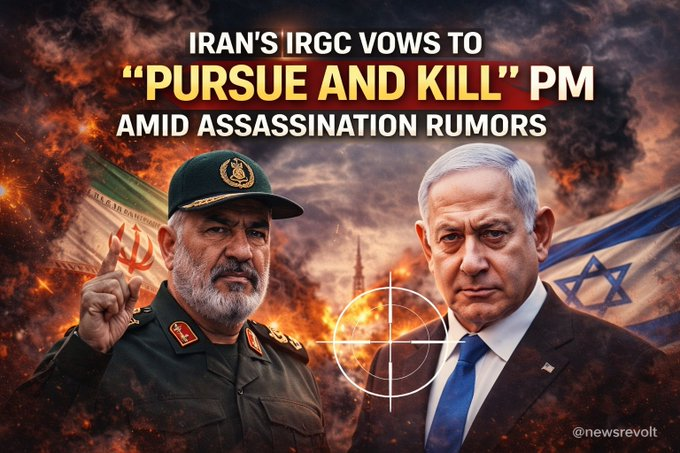
Iran’s Islamic Revolutionary Guard Corps issued a direct public assassination threat against Israeli Prime Minister Benjamin Netanyahu on March 15, 2026, calling him a “child-killing criminal.” The threat came on day 16 of the Iran-Israel-US conflict, hours after Netanyahu’s office dismissed viral assassination rumours as fake news. Here is a full breakdown of what was said, why it was said, and what it signals about the wider conflict.
By NewsRevolt India Desk | Published: March 15, 2026 | New Delhi
In a statement published on Sepah News, the official website of Iran’s Islamic Revolutionary Guard Corps, the IRGC issued one of the most direct public assassination threats seen in the current conflict: “If this child-killing criminal is alive, we will continue to pursue and kill him with full force.”
The target was Israeli Prime Minister Benjamin Netanyahu. The statement was issued on March 15, 2026, on day 16 of the Iran-Israel-US armed conflict, hours after Netanyahu’s office had been forced to publicly deny viral social media claims that he had been assassinated.
The Assassination Rumour That Triggered the Threat
The sequence of events on March 15 began not with a military strike, but with a social media spiral.
Viral posts across X and Telegram began circulating claims that Netanyahu had been killed or critically wounded in an Iranian strike. The claims spread rapidly, amplified by accounts with large followings across multiple countries. One widely shared video allegedly showing Netanyahu addressing the conflict drew speculation about what users described as an “AI glitch” — a claimed sixth finger visible in the footage, which some interpreted as evidence the video was artificially generated.
Netanyahu’s office moved quickly to contain the disinformation. It issued a formal statement describing the assassination claims as “fake news” and confirming that the Prime Minister was “fine.”
The IRGC’s response to that denial was the statement that drew global attention. Rather than ignoring the denial or simply claiming credit for strikes, the Guards published a threat that effectively said: he may be alive now, but we intend to change that.
What the IRGC Statement Actually Said
The statement carried by Sepah News described Netanyahu as a “criminal and child-killer” and declared that Iranian forces would continue to pursue and kill him “with full force” if he remained alive.
The language was deliberate on multiple levels. By framing the threat as conditional on Netanyahu’s survival, the IRGC statement implicitly reinforced the assassination rumours it was responding to, without confirming or denying whether an attempt had been made.
The IRGC also used the moment to reference strikes on US military infrastructure, with separate reports confirming the Guards had targeted three US air bases in the region in the same period, escalating the conflict beyond the direct Iran-Israel confrontation into a broader US-Iran military exchange.
The Broader Conflict Context
This statement did not emerge in isolation. It came on day 16 of a conflict that ACLED, the conflict data monitoring organisation, has described as an “unprecedented campaign” by a US-Israeli coalition that had already recorded hundreds of strikes across at least 26 of Iran’s 31 provinces.
The campaign had targeted Iranian air defences, ballistic missile capabilities, IRGC bases, leadership compounds, and national broadcasting infrastructure. Iranian Supreme Leader Ali Khamenei had reportedly been killed in the initial strikes. The IRGC had ordered evacuation of border cities and was operating under conditions of severe military pressure.
On March 18, in a major escalation, Israel struck Iran’s South Pars natural gas field with US coordination, triggering Iran’s retaliatory strike on Qatar’s Ras Laffan LNG facility — the attack that would go on to trigger a global energy crisis.
The IRGC’s assassination threat against Netanyahu was therefore not only a military declaration. It was a signal of institutional survival and ideological continuity at a moment when Iran’s military and leadership infrastructure were under sustained and unprecedented pressure.
The Information War Running Alongside the Military One
One dimension of this conflict that distinguishes it from previous Iran-Israel confrontations is the scale and sophistication of the parallel information war.
Disinformation campaigns, including those attributed to Iranian-affiliated media, have run alongside military operations from the conflict’s earliest days. The assassination rumours about Netanyahu were consistent with a broader pattern of information operations designed to create confusion about command and control on the Israeli side, generate domestic pressure within Israel, and signal to international audiences that the conflict’s outcome remained uncertain.
The IRGC’s public threat, published on its own official channels, served as both a military communication and an information operation in its own right. It corrected the narrative that Netanyahu was already dead while simultaneously amplifying the message that he remained a marked target.
For India, as for every country watching the conflict, the information environment around the Iran-Israel war demands the same standard that applies to the military one: verify before amplifying, and distinguish between official statements, confirmed facts, and deliberate disinformation.
What It Signals
Israel’s government has confirmed Netanyahu is safe. The IRGC’s threat has not been withdrawn.
The confrontation between Iran and Israel, in its military, diplomatic, and informational dimensions, remains active and unresolved. The public assassination threat issued by the IRGC against a sitting head of government is without recent precedent in the region’s modern conflict history, and it reflects the degree to which both sides have crossed thresholds that previous confrontations had, however reluctantly, maintained.
What happens next in this conflict will shape the Middle East, global energy markets, and India’s economic stability for years to come.
By NewsRevolt India Desk | newsrevolt.in