



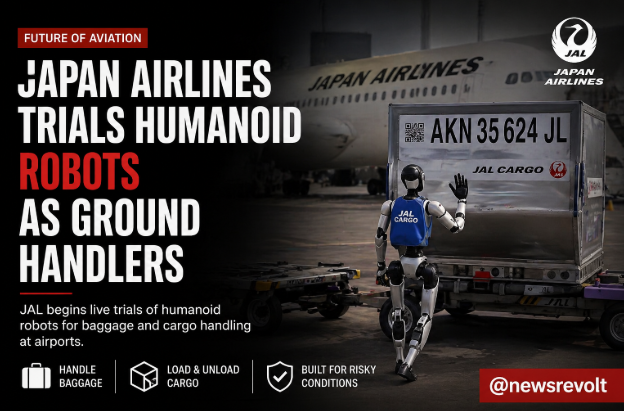
Japan Airlines (JAL), one of Asia’s largest and most respected carriers, has taken a bold leap into the future by trialing humanoid robots as airport ground handlers. The move marks a significant milestone in aviation history and raises critical questions about the future of human employment in one of the world’s most labor-intensive industries.
What Are the Robots Doing?
Unlike the automated conveyor systems or luggage carousels that airports have used for years, these are fully bipedal, human-shaped robots designed to perform complex physical tasks on the tarmac. JAL’s trials involve deploying these machines for baggage handling, cargo loading and unloading, and other ground operations that are traditionally carried out by human workers.
The robots are being tested during live airport operations, not just in controlled laboratory environments, making this one of the most ambitious real-world robotics deployments in aviation history.
Why Is Japan Airlines Turning to Robots?
The answer lies in Japan’s deepening demographic and labour crisis. Japan has one of the world’s oldest populations, with a rapidly shrinking workforce struggling to fill physically demanding roles across multiple industries. Ground handling, which involves heavy lifting, working in extreme weather conditions, and operating under strict time pressure, has become increasingly difficult to staff.
For JAL, humanoid robots are not a cost-cutting gimmick; they are a practical solution to a workforce gap that threatens operational efficiency. By automating high-risk, physically gruelling tasks, the airline also aims to significantly reduce workplace injuries among ground staff.
The Technology Behind the Robots
JAL is working with leading robotics companies to bring this technology to the tarmac. The humanoid robots are equipped with advanced sensors, AI-powered navigation systems, and mechanical limbs capable of mimicking human movement with precision. This allows them to adapt to the unpredictable, fast-paced environment of an airport, a far more challenging setting than a factory floor.
A Global Wake-Up Call for the Aviation Industry
While Japan’s labour shortage is the immediate driver, the implications are global. The aviation sector employs approximately 87 million people worldwide, with ground handling representing a substantial portion of that workforce. Once humanoid robot technology is proven at scale, and costs come down as they inevitably will, airlines across the world will face enormous economic pressure to adopt similar systems.
This mirrors patterns seen in other industries. ATMs gradually replaced bank tellers. Self-checkout machines reduced cashier roles in retail. The automation wave does not ask for permission; it follows economics.
For a country like India, where airports are expanding rapidly and aviation employment is growing, this development deserves serious attention. Policymakers, aviation companies, and workers’ unions must begin conversations today about reskilling, regulation, and the role of automation in the country’s aviation ambitions.
What Comes Next?
JAL’s trials are still in early stages, and widespread deployment is likely years away. However, the fact that a major international airline is conducting live operational trials signals that this technology is no longer a distant concept; it is arriving faster than most people anticipated.
If the trials succeed, expect other major airlines to fast-track their own robotics programs. The race to automate aviation’s ground operations has officially begun.
Stay tuned to NewsRevolt.in for the latest updates on technology, aviation, and how emerging innovations are reshaping industries across the globe.