



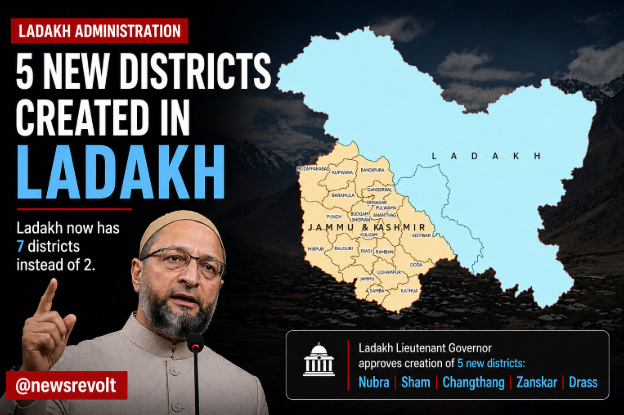
The Government of India has created five new districts in Ladakh, taking the total from two to seven. AIMIM chief Asaduddin Owaisi has called it a deliberate attempt to divide the joint Buddhist-Muslim statehood movement through demographic gerrymandering. The numbers behind the new boundaries deserve serious scrutiny.
By NewsRevolt India Desk | Published: April 29, 2026 | New Delhi
On April 27, 2026, Ladakh Lieutenant Governor Vinai Kumar Saxena approved the creation of five new districts in the Union Territory of Ladakh, increasing the total number of districts from two to seven.
The five new districts are Nubra, Sham, Changthang, Zanskar, and Drass. They join the existing districts of Leh and Kargil, which had been the only two administrative divisions in Ladakh since it was carved out of Jammu and Kashmir and designated a Union Territory following the revocation of Article 370 in 2019.
The Ministry of Home Affairs had originally cleared the proposal in August 2024 under Home Minister Amit Shah, and the formal notification came on April 27 — three days before Amit Shah’s scheduled two-day visit to Leh on April 30 to review development, security, and what Republic TV described as the “political roadmap for Ladakh.”
The Government’s Case for the New Districts
The official rationale presented by LG Saxena and the Union government is straightforward: Ladakh is one of the largest Union Territories by area in India, with residents in remote areas living up to 300 kilometres from the nearest district headquarters in Leh or Kargil.
PM Modi congratulated the people of Ladakh and said the new districts would bring government services, development, and opportunities closer to residents in far-flung border areas. LG Saxena called it a “historic milestone” aligned with PM Modi’s vision of a developed and prosperous Ladakh.
From a purely administrative standpoint, the argument has merit. Ladakh’s vast and difficult terrain, its strategic border location with China and Pakistan, and the logistical challenges of service delivery across such distances do justify some form of administrative decentralisation. More than 97 percent of the population in the new districts belongs to Scheduled Tribes, including the Balti Shia, Boto, Brokpa, and Changpa communities.
Owaisi’s Gerrymandering Charge
AIMIM chief Asaduddin Owaisi posted on X on April 28, 2026: “The govt has created 5 new districts in Ladakh. There are now 7 districts instead of 2. The govt wants to divide the unified statehood movement of Buddhists and Muslims. This is another gerrymandering in the erstwhile state of Jammu and Kashmir.”
That charge requires a factual examination.
According to the 2011 Census, Ladakh’s total population stood at 274,289. Muslims comprise 46.40 percent of that population — the largest single religious community in Ladakh. Buddhists comprise 39.65 percent — the second largest.
Now, examine how the seven districts distribute demographically.
Buddhist-majority districts: five — Leh, Nubra, Sham, Changthang, and Zanskar.
Muslim-majority districts: two — Kargil and Drass.
In direct terms: the community representing 39.65 percent of Ladakh’s population receives five of the seven districts. The community representing 46.40 percent of Ladakh’s population receives two of the seven districts.
That is the factual basis of Owaisi’s proportionality argument, and it is not a figure that can be dismissed without a direct, data-backed rebuttal.
The Statehood Movement at Stake
The context that gives Owaisi’s accusation its sharper edge is the ongoing joint statehood movement in Ladakh.
Since Article 370 was revoked in 2019, Ladakh has had no elected legislative assembly. It is governed directly by the Union Home Ministry through the Lieutenant Governor. Residents across both Leh and Kargil — Buddhists and Muslims — have been jointly demanding the restoration of full statehood and constitutional protections under the Sixth Schedule of the Constitution, which provides legislative safeguards to tribal areas.
That cross-community alliance between Buddhists and Muslims, built on the shared grievance of lost democratic representation, has been one of the most politically significant developments in Ladakh since 2019.
Owaisi’s argument is that the new district boundaries have been deliberately drawn to give the two communities separate administrative identities, with Buddhist-majority areas gaining greater numerical representation in district governance structures. Whether that was the intent behind the boundary design is a question that demands a transparent, documented answer from the Ministry of Home Affairs.
The Timing Question
The announcement on April 27, three days before Amit Shah’s political visit to Leh on April 30, is not the kind of coincidence that administrative decisions of this scale typically produce.
Major district reorganisations involve months of planning, mapping, staffing, and budgetary preparation. The proximity of the notification to the Home Minister’s visit suggests the announcement was designed to frame the political environment ahead of what Republic TV called a review of the “political roadmap for Ladakh.”
That timing does not confirm the political intent behind the boundary design. But it does confirm that this was as much a political act as an administrative one, and it deserves to be covered and scrutinised as both.
Two Things Can Be True
Administrative decentralisation in a region as geographically vast and strategically critical as Ladakh can be a genuine governance need. And boundary drawing that does not reflect demographic proportionality can simultaneously raise legitimate questions about political motivation.
Both of those things are true in this case. The government has not addressed the proportionality concern. Owaisi has raised it with specific demographic data. The public and Ladakh’s residents deserve a direct, data-backed response from the Ministry of Home Affairs — not silence, and not a development narrative that sidesteps the question entirely.
By NewsRevolt India Desk | newsrevolt.in