



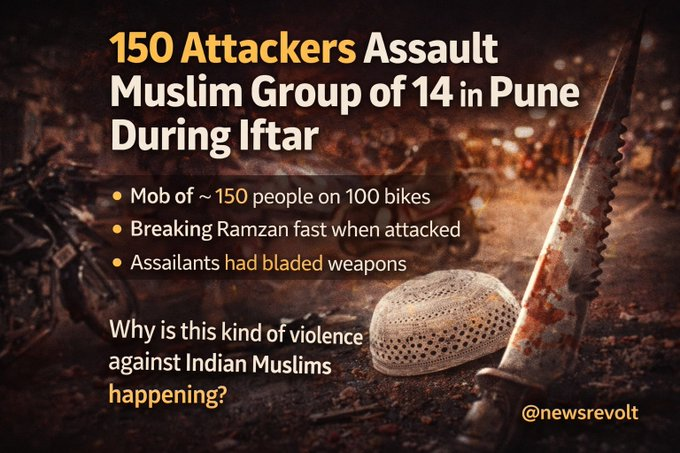
On March 13, 2026, a group of 14 Muslim men was attacked by a mob of approximately 150 people near a lakeside in Askarwadi, Pune, while breaking their Ramzan fast. At least 11 were injured. Police registered an FIR against 150 unidentified persons. Four days later, no arrests had been made. The case raises serious questions about mob violence, police response time, and the safety of minorities exercising religious practices in public spaces.
By NewsRevolt India Desk | Published: March 17, 2026 | Pune, Maharashtra
At approximately 7 pm on the evening of March 13, 2026, fourteen men from Kondhwa in Pune had gathered by a lakeside at Askarwadi near Bopdev Ghat to break their Ramzan fast. They had brought food packets, arranged their Iftar meal, and settled near the water at a location they had reportedly used for the same purpose over the past five to six years.
Before the meal could begin, a mob arrived on approximately 100 motorcycles.
What followed was a coordinated assault that left at least 11 of the 14 men injured, sent victims fleeing to save their lives, and triggered an FIR against 100 to 150 unidentified persons at Saswad police station. Four days after the incident, not a single arrest had been made.
What Happened at Bopdev Ghat
Complainant Feroz Sayyed, 36, who runs a cloth stall on MG Road in Pune’s Camp area, described the attack in his FIR and in subsequent statements to media.
The group had arrived at the lakeside area on motorcycles and in a car. Within a short time, a large mob surrounded them, questioning their presence at the location and asking whether the land belonged to them. Before the group could respond, the assault began.
The attackers used sticks, iron rods, whips, and other sharp weapons. They removed the victims’ skullcaps. The mob reportedly told the victims that no display of Muslim identity was permitted in that area.
“There were 14 of us and nearly 200 men surrounded us. They removed our caps and assaulted us. The police did not act on our complaint for nearly five hours,” victim Abrar Khan told reporters. “It is a public place that belongs to all citizens.”
Most of the injured sustained head, back, and leg injuries. They made their own way to a hospital in Kondhwa for treatment after the attack.
The Police Response
Saswad Police Sub-Inspector Kumar Kadam confirmed that an FIR was registered under multiple sections of the Bharatiya Nyaya Sanhita, including sections 118(1), 189(2), 190, 191(2), 191(3), 351(2), 351(3), and 352, as well as provisions of the Indian Arms Act.
The FIR named 100 to 150 unidentified persons. As of March 17, 2026, four days after the attack, Newslaundry reported that no arrests had been made.
Inspector Kadam told the Times of India that police had identified three assailants from CCTV footage and were working to identify the rest. Saswad police said they were also investigating whether the assailants were affiliated with any organisation.
Pune Rural Superintendent of Police Sandeep Singh confirmed the registration of the case and said an investigation was underway.
The five-hour delay in registering the initial complaint, alleged by victims, has not been formally addressed by the police or district administration.
Organised, Not Spontaneous
Multiple elements of the Bopdev Ghat attack point to coordination rather than a spontaneous confrontation.
Approximately 150 individuals arrived at a rural lakeside location in convoy on roughly 100 motorcycles, at a specific time coinciding with the Iftar gathering, armed with sticks, rods, and sharp weapons.
Social activist and SDPI leader Taj Siddiqui said the assault was pre-planned. “According to our information, the accused came together from nearby villages and carried out a planned attack on youths who had gathered to break their Ramzan fast. The victims sustained serious head injuries and were mercilessly beaten.”
Local activists who spoke to Newslaundry after the attack said the incident was not isolated, but reflected what they described as a systemic pattern of mob violence targeting Muslims in rural areas around Pune.
The Larger Issue: Public Spaces, Public Rights
Bopdev Ghat is a popular tourist spot. The lakeside at Askarwadi is a public location, accessible to all citizens. The group of 14 men had gathered there peacefully, as they reportedly had for several years during Ramzan, without prior incident.
The fact that a mob of 150 could descend on that location, assault 14 people for the act of breaking a religious fast, remove their religious headgear, issue explicit warnings about the display of Muslim identity, and then leave without a single arrest for four days is not merely a law and order failure. It is a signal about what happens when mob violence against a minority community fails to generate immediate accountability.
When attacks of this nature go unanswered in the days immediately following them, the message received by both perpetrators and intended victims is the same: certain public spaces, and the rights they are supposed to guarantee equally, are not equally enforced.
Maharashtra’s law enforcement agencies owe a clear, public, and time-bound answer on the progress of this investigation — and on why five hours passed before the initial complaint was recorded.
By NewsRevolt India Desk | newsrevolt.in