

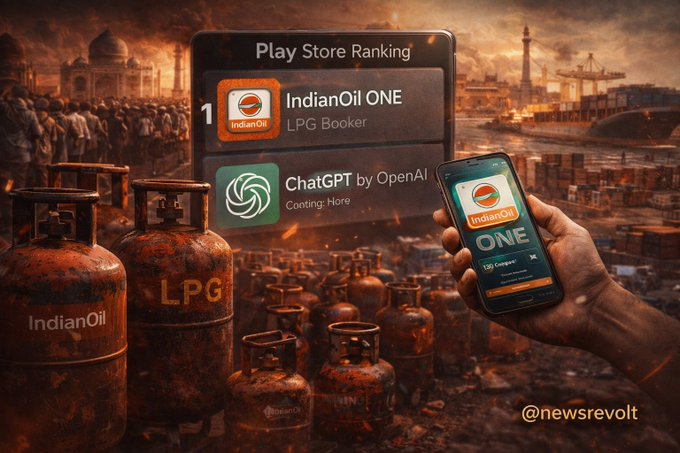
IndianOil ONE, the government’s LPG cylinder booking app, overtook ChatGPT to become India’s most downloaded app on both Google Play Store and Apple App Store in March 2026. The statistic is striking. The reason behind it is more serious than any app ranking.
By NewsRevolt India Desk | Published: March 18, 2026 | New Delhi
For a few days in March 2026, the most downloaded app in India was not a social media platform, not a streaming service, and not an artificial intelligence tool. It was IndianOil ONE — a government app used for booking LPG cooking gas cylinders.
It overtook ChatGPT. It overtook every popular app on both the Google Play Store and Apple App Store. According to download trend tracker Sensor Tower, the IndianOil ONE app held the top position in free downloads in India for several consecutive days, ranking first on Play Store between March 13 and March 15 and remaining the most downloaded free app on the App Store since March 11.
That ranking is not a tech story. It is an energy crisis story.
Why Millions Downloaded a Gas Booking App
The immediate trigger was a supply shock that hit India with unusual speed and severity.
Following US and Israeli military strikes on Iran in late February 2026, Tehran effectively closed the Strait of Hormuz to commercial shipping in what Union Petroleum Minister Hardeep Singh Puri described as the first such closure in recorded history.
The consequences for India were immediate and structural. India imports approximately 60 percent of its LPG, and over 90 percent of those imports transit the Strait of Hormuz. When that single passage closed, India’s functional LPG buffer — accounting for pipeline and bottling-plant working stocks — was closer to ten days, not the 25 to 30 days of nominal inventory that policy frameworks had assumed.
Within the first two weeks, weekly LPG inflows to India fell by an estimated 30 percent. Maritime insurers withdrew war-risk cover from Gulf-region tankers or repriced it beyond commercial viability, with premiums reportedly surging over 1,000 percent. QatarEnergy declared Force Majeure. Saudi Aramco’s loading terminal was disrupted.
The result on the ground was visible in every Indian city. LPG distribution centres saw long queues. Delivery systems were overloaded. Consumers using the IndianOil ONE app reported repeated errors, failed bookings, and cancelled orders as the platform struggled under the surge in demand.
The Numbers Behind the App Surge
On March 12, 2026 alone, household LPG bookings in India surged over 35 percent to 75.7 lakh cylinders in a single day, up from approximately 55 lakh on normal days.
In the preceding 30 days, IndianOil ONE recorded over four million downloads.
India has over 33.4 crore LPG connections. Piped natural gas, the most viable alternative, serves approximately 1.5 crore households. The overwhelming majority of Indian homes depend on cylinder-based LPG for daily cooking, and when that supply came under threat, the response was immediate, mass, and driven by basic survival need rather than digital enthusiasm.
India’s Structural Vulnerability Exposed
The app ranking was a symptom. The disease had been developing for years.
India’s LPG consumption has doubled over the past decade, from approximately 15 million metric tonnes in 2012 to around 31 million metric tonnes in 2025. Over the same period, domestic production has not kept pace with demand, and import dependence has grown steadily.
Four structural failures had been compounding quietly before the crisis broke: over-concentration of import routes through a single maritime corridor, near-total dependence on West Asian suppliers for over 90 percent of import cargo, negligible strategic LPG storage capacity, and an absence of meaningful supply diversification.
When the Hormuz closure arrived, India had no buffer capable of absorbing the shock.
The government’s response was structured. Refineries were directed to maximise LPG output, producing a 28 percent production boost within five days. Emergency procurement was initiated from the United States, Norway, Canada, Algeria, and Russia, reducing Gulf dependency from 99 percent to approximately 70 percent of imports. The LPG booking extension period for urban households was increased from 21 to 25 days.
India’s LPG crisis, according to analysts at Firstpost, may take up to four years to fully normalise given the scale of damaged Gulf infrastructure and the limited pace at which alternative supply chains can be built.
What the App Ranking Actually Means
The moment IndianOil ONE overtook ChatGPT, it communicated something that no economic report could frame as sharply.
In a country of 33.4 crore LPG connections, when cooking gas becomes uncertain, artificial intelligence becomes irrelevant. The most urgently downloaded technology in India was not a language model capable of writing essays or generating images. It was a platform designed to answer one question that millions of households needed answered immediately: when is my cylinder coming.
That question, and the anxiety behind it, is a direct consequence of decades of under-investment in energy storage, an over-reliance on a single import corridor, and a domestic production base that has not scaled to meet demand.
The LPG crisis of 2026 is India’s clearest signal yet that energy security cannot be treated as a background policy consideration. It is a front-line national priority, and the IndianOil ONE download chart proved it more effectively than any government report.
By NewsRevolt India Desk | newsrevolt.in