



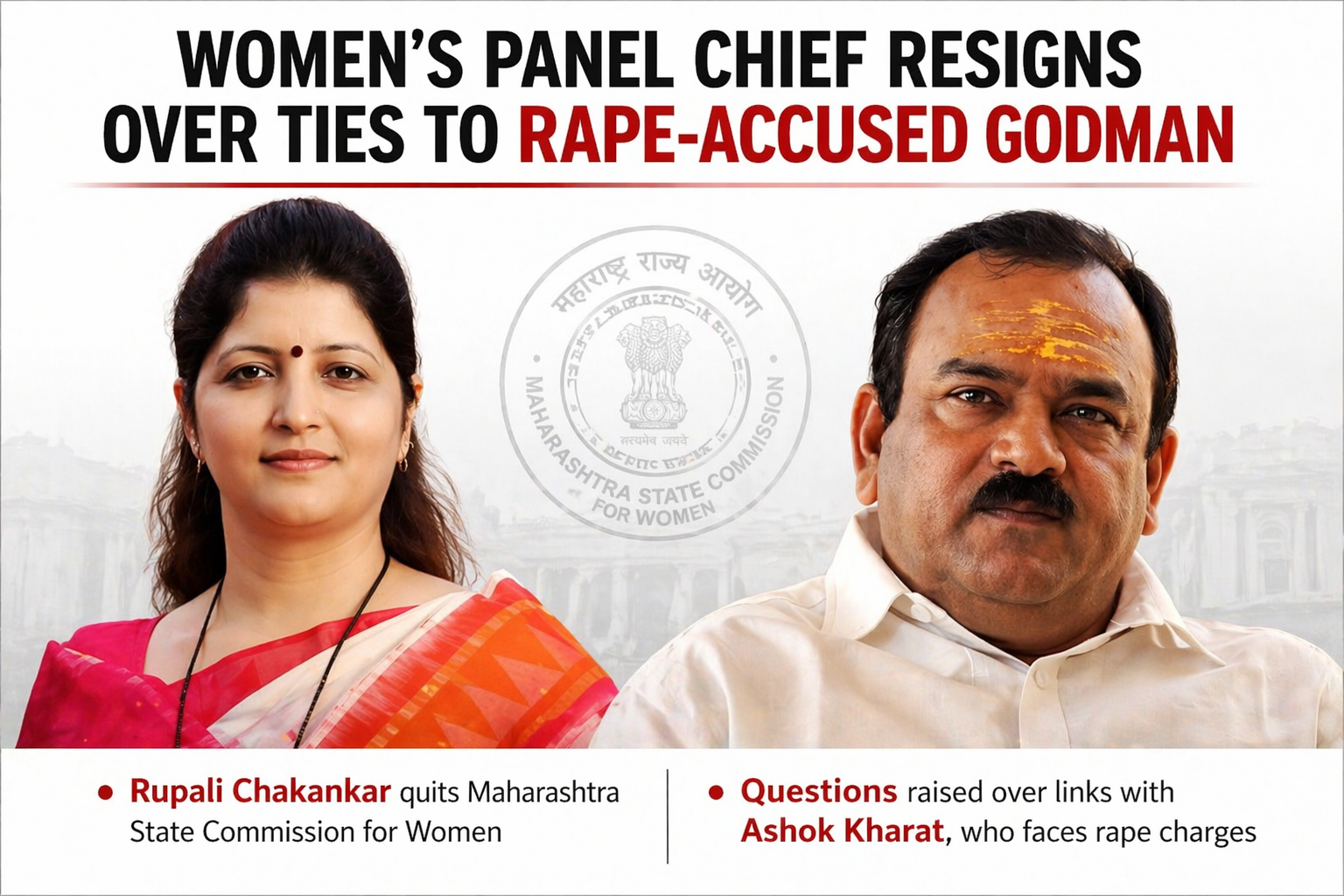
The chairperson of the Maharashtra State Commission for Women stepped down after controversy erupted over her alleged association with a spiritual figure accused of sexually assaulting multiple women. The resignation raises uncomfortable questions about who guards the institutions meant to guard women.
By NewsRevolt India Desk | Published: April 21, 2026 | Mumbai, Maharashtra
Rupali Chakankar has resigned as Chairperson of the Maharashtra State Commission for Women, becoming the latest casualty of a scandal that has exposed the dangerous intersection of political appointments, blind spiritual faith, and institutional compromise.
Her departure, which came after Maharashtra Chief Minister Devendra Fadnavis reportedly asked her to step down, was triggered by the surfacing of photographs and documented associations linking her to Ashok Kharat, a self-styled godman currently under arrest in a sexual assault case. Kharat stands accused of exploiting multiple women, allegedly using the cover of spiritual guidance to gain their trust before abusing it.
The irony is stark and the public outrage is justified. The head of a statutory body whose sole mandate is to protect women in Maharashtra had allegedly maintained an association with a man accused of systematically violating them.
Who Is Ashok Kharat
Ashok Kharat operated as a spiritual figure who built influence through religious trust. According to reports surrounding his arrest, he is accused of sexually assaulting women who had approached him seeking spiritual counsel. Investigators allege that he exploited the faith of his followers, using his religious stature as both a shield against scrutiny and a tool for manipulation.
His case follows a pattern that Indian law enforcement and civil society have documented repeatedly across the country. Fake godmen and self-styled spiritual authorities exploit the vulnerability of devotees, particularly women, for years before formal complaints result in legal action. The community of believers around such figures often serves, whether knowingly or not, as a layer of protection that delays accountability.
Chakankar’s Defence and Her Resignation
Rupali Chakankar did not accept the framing of deliberate wrongdoing. She said she was unaware of the nature of Kharat’s alleged crimes, and that her association with him was rooted in spiritual faith rather than any knowledge of his conduct toward other women. She stated she was resigning voluntarily to allow a fair and independent investigation to proceed without her position becoming a distraction.
Whether that explanation is accepted is a matter for investigators and the public to assess. What is not in dispute is the core institutional reality her tenure exposed: the vetting process for appointments to statutory women’s rights bodies in Maharashtra was evidently insufficient to flag an association that has now become a matter of criminal relevance.
The Institutional Failure Behind the Headlines
The Maharashtra State Commission for Women is not a ceremonial body. It holds quasi-judicial powers, receives complaints from women across the state, issues notices to government departments, and is positioned as a first point of accountability for violations of women’s rights. Its chairperson is expected to carry not just formal qualifications but an unimpeachable personal and institutional record.
The appointment of Chakankar, whatever her own intentions or the merits of her work in other areas, bypassed a due diligence standard that should have been applied with particular rigour to this role. Political opposition was quick to raise this point after the controversy broke. The broader question of how such appointments are made, and who reviews them, has now entered public discourse with fresh urgency.
A Pattern That Must Not Be Normalised
India has seen this pattern before. A figure of religious or social authority accumulates power over vulnerable people. Political and institutional connections provide cover. Complaints surface, then multiply. Legal action comes late. And in the aftermath, the collateral damage extends to institutions that had, knowingly or unknowingly, lent their credibility to the accused.
That collateral damage is now visible in the Maharashtra Commission for Women. One of the state’s most important protective bodies for women has had its credibility publicly questioned at a time when trust in such institutions is already fragile.
Chakankar’s resignation is the beginning of accountability, not the end of the story. The Commission must now demonstrate, through transparent appointment processes and independent investigation, that it can restore public confidence.
More fundamentally, the question that this episode leaves behind is not only about Rupali Chakankar or Ashok Kharat. It is about whether the systems that appoint people to positions of trust over the vulnerable are themselves trustworthy enough to be trusted with that responsibility.
That question deserves a straight answer.
By NewsRevolt India Desk | newsrevolt.in
Sources: NewsRevolt India reporting, Maharashtra political statements, arrest records related to Ashok Kharat case. Published April 21, 2026.