



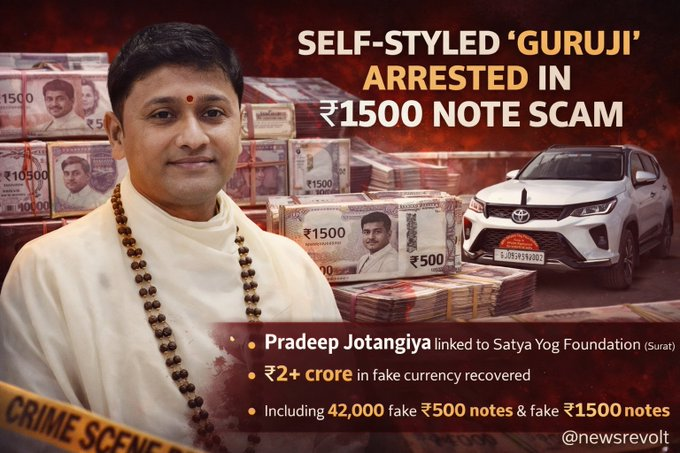
Pradeep Jotangiya, associated with the Satya Yog Foundation in Surat, has been arrested for operating a structured fake currency network. Police recovered over 42,000 fake ₹500 notes and counterfeit ₹1500 notes — a denomination that does not legally exist in India.
By NewsRevolt India Desk | Published: March 20, 2026 | Surat, Gujarat
He presented himself as a spiritual guide. Behind that identity, police allege, he was running one of the more unusual fake currency operations Gujarat has seen in recent years.
Pradeep Jotangiya, associated with the Satya Yog Foundation in Surat, has been arrested for allegedly operating a large-scale counterfeit currency racket. Authorities recovered fake notes with a face value exceeding ₹2 crore from the operation, along with approximately 42,000 fake ₹500 notes. The case also includes something rarely seen in Indian currency fraud: the circulation of fake ₹1500 notes — a denomination that does not exist in the Indian monetary system.
The Scam and How It Worked
The operation worked on a straightforward but effective principle of manufactured greed.
Buyers were offered fake ₹500 notes at a discount, with the expectation that they would circulate those notes as genuine currency and pocket the difference. The introduction of fake ₹1500 notes — sold at ₹500 each — added an additional layer to the scheme, exploiting a combination of financial opportunism and basic unawareness about Indian currency denominations.
The Reserve Bank of India has never issued a ₹1500 note. The denomination has no legal existence. Yet the network reportedly found buyers willing to purchase these notes, either through ignorance or through the expectation that others would accept them without scrutiny.
The scale of the recovery — over 42,000 fake ₹500 notes alone — confirms this was not an informal side operation. It was a structured, volume-driven counterfeiting network with a distribution mechanism attached to it.
The “Guruji” Cover
Jotangiya’s association with the Satya Yog Foundation in Surat provided him with the kind of community credibility that makes fraud easier to sustain.
The use of spiritual identity as cover for financial crime is not new in India. It follows a pattern seen across multiple states where figures operating under religious or spiritual branding use their social standing to generate trust, lower the guard of potential victims or buyers, and insulate themselves from early scrutiny. By the time formal suspicion develops, the operation has often already scaled considerably.
In this case, the “Guruji” framing also created a buffer against immediate accountability. People who believed they were dealing with a spiritual figure associated with a registered foundation were less likely to treat the transaction as the criminal exchange it allegedly was.
Why Fake Currency Causes Real Damage
Counterfeit currency operations are not victimless crimes. The damage they cause moves through the economy in ways that disproportionately hurt small businesses, daily wage earners, and street traders who lack the resources to verify every note they receive.
When fake notes enter circulation, the losses land with whoever ends up holding them at the point of discovery. A vegetable vendor, a small shopkeeper, an auto driver — none of these individuals have the verification tools that banks do. The ₹500 notes recovered in this case, if successfully circulated, would have left that burden on the people least equipped to absorb it.
Fake currency also erodes trust in cash transactions at a broader level, creating friction in an economy where physical currency remains the dominant medium for millions of people, particularly in semi-urban and rural areas.
Both Sides of the Transaction Are Criminal
One aspect of this case that deserves to be stated clearly is that buyers of fake currency are not victims in the legal sense. Anyone who knowingly purchases counterfeit notes with the intent to use them as genuine currency is committing an offence under the Indian Penal Code and the Counterfeit Currency (Offences) Act.
The network that Jotangiya allegedly operated depended on finding people willing to exploit the system — buyers who believed they could purchase fake notes cheaply, spend them as real, and profit from the difference. That willingness is not a form of savviness. It is complicity in a financial crime that ultimately harms the wider public.
Police have confirmed that the investigation is ongoing. Further links and associates within the network may yet be identified.
The Larger Reminder
This case illustrates a principle that applies well beyond currency fraud: scams do not require technical sophistication to succeed. They require willing participants, a credible cover, and a human tendency to believe that an unusually good offer is an opportunity rather than a warning.
A “Guruji” selling ₹1500 notes for ₹500 in Surat relied on exactly that tendency. The arrest has ended one node of the network. Whether the full operation has been dismantled is a question the ongoing investigation will need to answer.
By NewsRevolt India Desk | newsrevolt.in