



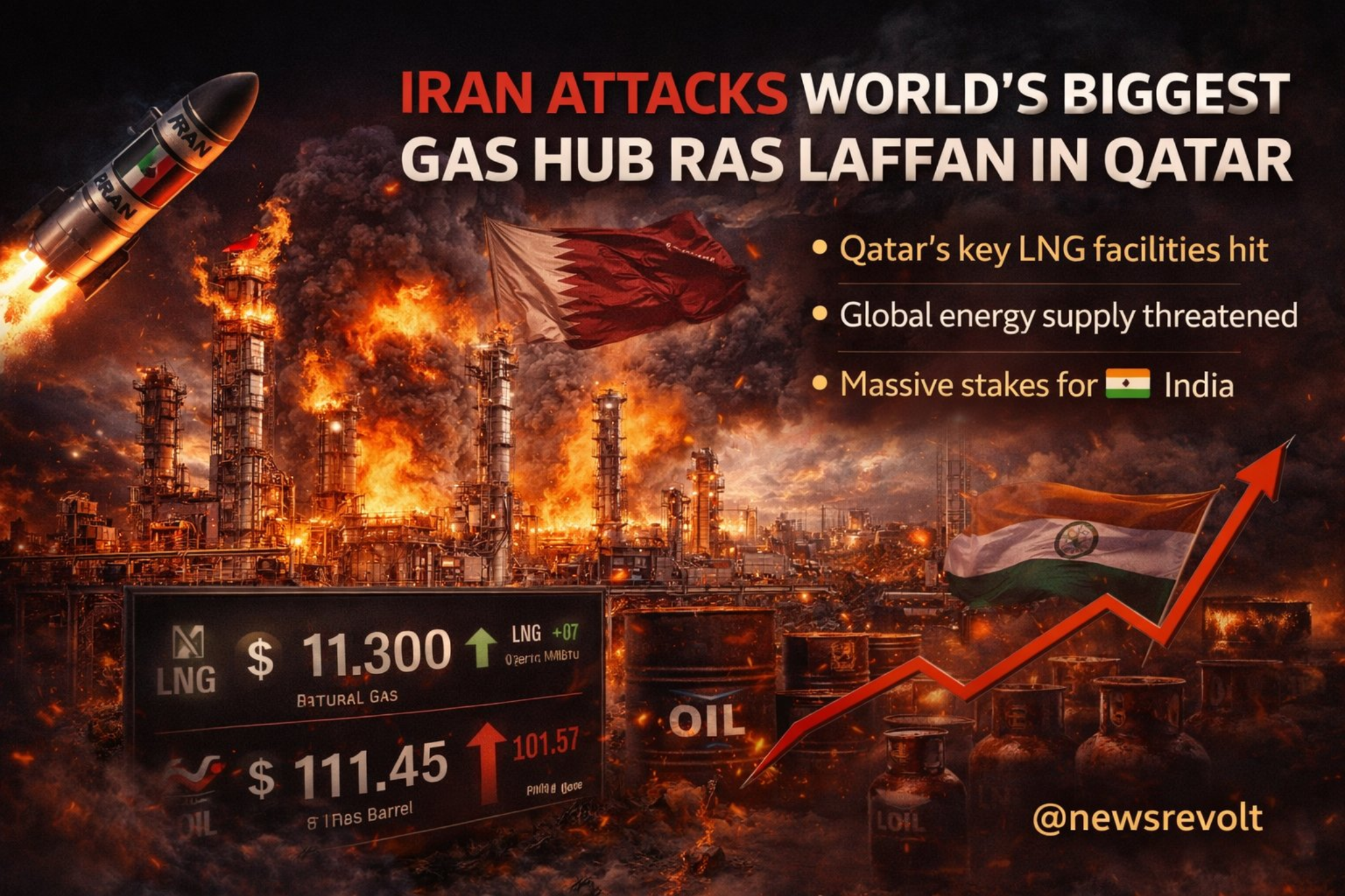
Iranian missiles struck Ras Laffan Industrial City, the world’s largest LNG facility, causing extensive damage and halting production. For India, which imports nearly half its LNG from Qatar, this is not a distant geopolitical event. It is an energy and economic shock with direct consequences on fuel prices, power supply, and daily costs.
By NewsRevolt India Desk | Published: April 21, 2026 | New Delhi
On the night of March 18, 2026, Iranian missiles struck Ras Laffan Industrial City on Qatar’s northern coast in two successive waves, triggering massive fires and what QatarEnergy described as “sizeable fires and extensive further damage” to multiple liquefied natural gas facilities.
The attack was Iran’s retaliation for an Israeli strike on Iran’s South Pars gas field, part of the world’s largest known natural gas reserve. What began as an exchange between two adversaries has now delivered a shockwave through global energy markets, and few countries outside the Gulf are more exposed to the consequences than India.
What Is Ras Laffan and Why It Matters
Ras Laffan is not simply Qatar’s largest industrial complex. It is the single most important LNG export facility on the planet. The site handles approximately 20 percent of the world’s entire liquefied natural gas supply, making it a linchpin of energy security for importing nations across Asia and Europe.
Iran’s strikes have knocked out an estimated 17 percent of Qatar’s LNG export capacity, with damage described as long-term rather than easily repairable. QatarEnergy declared force majeure, triggering immediate supply interruptions for buyers who depend on scheduled Qatari deliveries.
Qatar responded by declaring the military and security attaches of Iran’s embassy persona non grata and demanding their immediate departure from Doha. The diplomatic fallout from the attack has deepened the uncertainty around how long and how severely the disruption will last.
India’s Direct Exposure
India is not a spectator in this crisis. It is among its most directly affected victims.
India relies on Qatar for approximately 40 to 50 percent of its total LNG imports. Petronet LNG, India’s largest gas importer, has already been forced to reduce deliveries by up to 40 percent following the attacks, with reduced allocations flowing through to city gas distribution networks, power generation facilities, and fertilizer manufacturing plants.
The numbers are stark. India imports over 88 percent of its crude oil and more than half its natural gas needs. Brent crude, which was trading around $69 per barrel in February 2026, surged to an average of $114 per barrel through March 2026, with peaks above $118 per barrel reported in the days immediately following the Ras Laffan strikes. A $10 per barrel rise in crude prices adds approximately $14 to $16 billion to India’s annual import bill.
The Indian Rupee weakened to around 94 against the US dollar by late March 2026, compounding the cost of every barrel imported and every LNG shipment contracted.
What This Means for Everyday Life in India
The consequences of the Qatar strikes are not abstract. They move through India’s economy in a direct chain.
Higher gas prices mean higher costs for power generation. Higher power costs mean higher manufacturing expenses across industries from steel to cement to pharmaceuticals. Higher fertilizer costs, driven by reduced gas allocations to plants, feed into agricultural input prices. And higher crude prices translate immediately into costlier petrol, diesel, and cooking gas for ordinary households.
Adani Total Gas, one of India’s largest city gas distributors, has already announced price increases in response to the supply shock. The Indian government moved to reduce excise duty on fuel and Oil Marketing Companies have been absorbing part of the cost burden to prevent immediate retail price spikes, but analysts warn that sustained high global prices will make that containment increasingly difficult to maintain.
India has also confirmed that current crude reserves are sufficient for approximately 60 to 74 days of consumption and that refineries are operating at full capacity, providing a short-term buffer. But a buffer is not a solution, and the longer the Middle East conflict continues to target energy infrastructure, the shorter that runway becomes.
The Larger Strategic Risk
The Ras Laffan strike has introduced a dimension to the Middle East conflict that goes beyond the immediate military confrontation between Iran and Israel. It has established that Gulf energy infrastructure, which underpins the economies of dozens of nations, is now a legitimate target in the conflict’s escalating logic.
Iran has also imposed a near-complete blockade of the Strait of Hormuz, through which approximately 40 percent of India’s crude imports pass. Any sustained closure or disruption of that waterway would render India’s short-term supply reserves critically important and force emergency procurement from alternative markets at significant premium.
India is already working to diversify supply, seeking alternative LNG shipments from the United States and Australia. But replacing Qatari volumes quickly, at scale, and at comparable cost is not straightforward. Long-term contracts, shipping distances, and regasification infrastructure all constrain how rapidly a switch can be made.
A War Fought on Energy, Not Just Battlefields
What the Ras Laffan strike demonstrates, with stark clarity, is that modern conflict increasingly targets economic architecture rather than military positions alone. A single missile strike on an industrial facility in Qatar has raised fuel prices in Mumbai, reduced gas allocations to factories in Gujarat, and widened India’s current account deficit in ways that will take months, if not years, to fully absorb.
Energy expert Narendra Taneja put the stakes plainly: “Attacks on gas production fields in the Persian Gulf are alarming news. No economy that relies on oil and gas imports is shielded; all will suffer serious consequences.”
India is not at war. But it is not insulated either.
What happens to a gas hub in Qatar does not stay in Qatar. It arrives at the petrol pump, the electricity bill, and the kitchen cylinder. That is the reality of energy dependence, and the Ras Laffan strike has made it impossible to ignore.
By NewsRevolt India Desk | newsrevolt.in
Published April 21, 2026.